
What Buyers Need to Check Before Launching DIY Crochet Kits in Different Markets
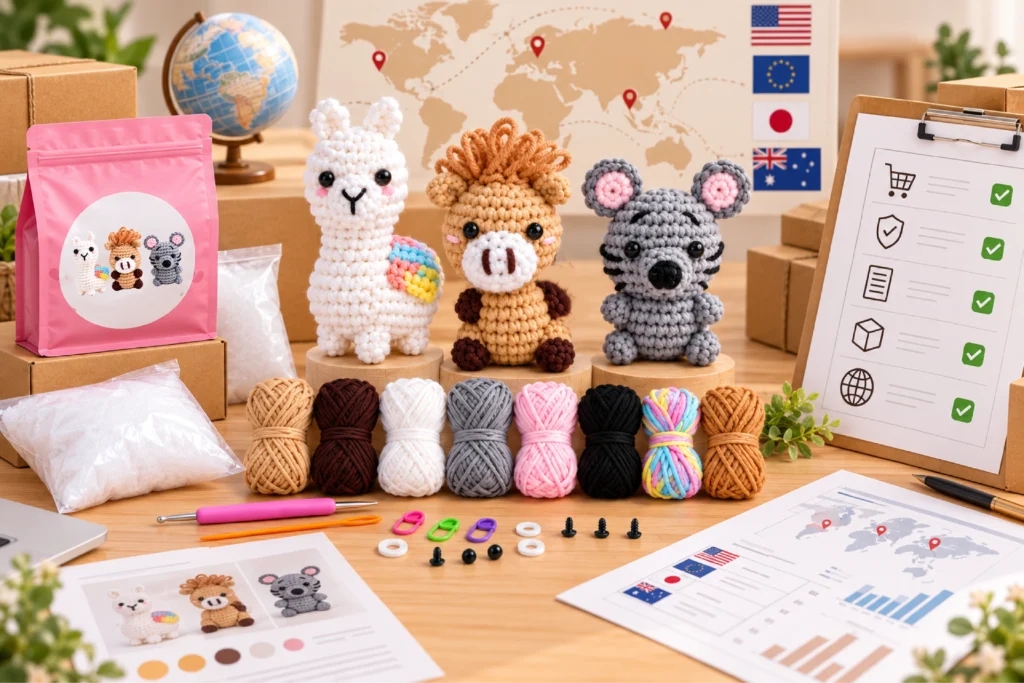
Before launching DIY crochet kits in a new market, buyers should confirm the product’s intended users, regulatory classification, component risks, applicable testing, labeling requirements, and responsible business entities. These decisions should be documented before packaging approval and bulk production. A report or label prepared for one market should not automatically be reused for another.
A crochet kit can combine yarn, stuffing, hooks, needles, small accessories, printed instructions, and packaging. Its regulatory position depends on more than the name “DIY craft kit.” The intended maker, marketing presentation, included components, and intended use of the finished project all matter.
For retailers, private-label brands, distributors, and educational buyers, the practical goal is to create a launch file that connects the product being sold with the evidence supporting its release.
This guide provides a buyer-focused review framework. The applicable requirements must be confirmed for the specific product, destination, and launch date.
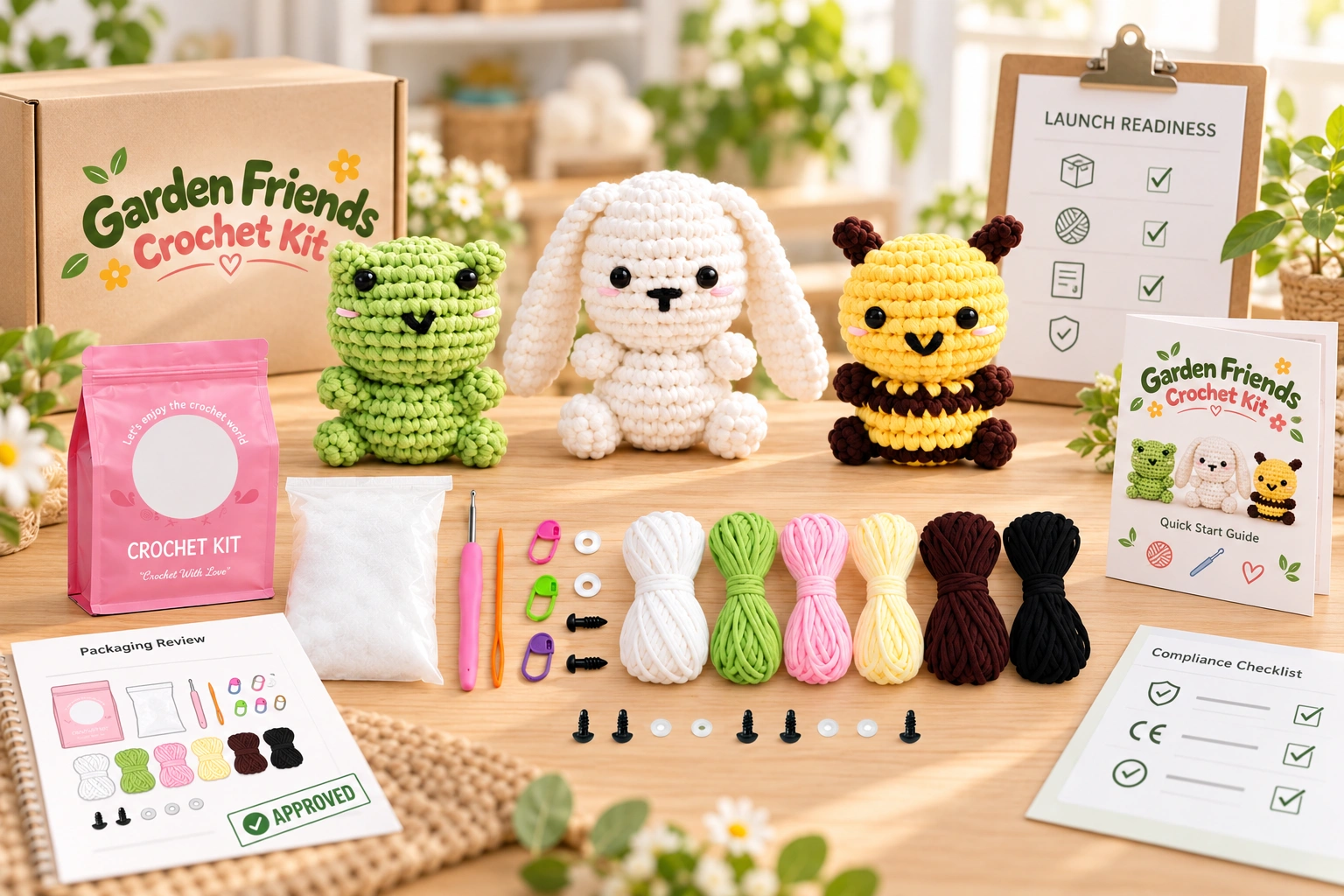
1. Define Who Will Use the Kit and What It Is Designed to Make
Start with a written intended-use brief.
Avoid descriptions such as “suitable for everyone.” They make it difficult to evaluate age suitability, hazards, packaging claims, and the relevant compliance route.
Record the following information:
| Decision | Information buyers should confirm |
|---|---|
| Intended maker | Adults, teenagers, or children within a defined age range |
| Expected skill level | Beginner, intermediate, or experienced |
| Use setting | Independent home use, supervised classroom activity, workshop, or another setting |
| Finished project | Decorative item, accessory, collectible, plaything, or another intended use |
| Included tools | Crochet hook, sewing needle, scissors, or other tools |
| Sales presentation | Packaging images, product descriptions, advertisements, and online listings |
| Destination | Specific countries, rather than broad descriptions such as “Europe” |
The maker and the recipient may be different people. An adult may assemble a crochet animal intended as a decorative collectible, or make one intended for a child to play with. These situations deserve separate assessment.
A printed age recommendation does not, by itself, establish the product’s regulatory classification.
Do not use an “adult use” or “14+” label as a substitute for a documented classification review.
2. Review Each Destination Market Separately
Create a separate compliance decision for each destination. Similar-looking products can have different obligations across markets.
The following table identifies starting points for review. It is not a complete list of applicable requirements.
| Destination | Initial classification question | Buyer’s next action |
|---|---|---|
| United States | Is the kit a general-use product, a children’s product, a toy, or subject to another applicable category? | Confirm applicable CPSC rules, testing obligations, certification, and labeling for the actual product. |
| European Union | Does the kit fall within toy legislation or another product-safety framework? | Confirm the applicable conformity route, technical documentation, labeling, and economic-operator obligations. |
| Great Britain | Does the product fall within the Toys (Safety) Regulations or other relevant requirements? | Verify the accepted conformity-marking route and the obligations applying to the manufacturer and importer. |
| Australia | Which mandatory standards, bans, and general product-safety obligations apply? | Check the actual product against applicable Australian requirements, including relevant toy requirements where appropriate. |
United States
CPSC guidance defines children’s products as products designed or intended primarily for children aged 12 or younger. Classification determines which requirements apply.
Where applicable children’s product safety rules require it, third-party testing and a Children’s Product Certificate are part of the compliance process. A generic supplier statement should not replace the required evidence.
Start with the CPSC guidance on children’s products.
European Union
For products classified as toys, the European Commission describes requirements including safety assessment, conformity assessment, technical documentation, a declaration of conformity, and CE marking.
CE marking should follow the applicable legal assessment. It should not be added to every crochet kit simply because the destination is the EU.
Check the legislation and any transition provisions applicable on the intended launch date. The Commission’s guidance on placing toys on the EU market provides a starting point.
Great Britain
Review the official Great Britain toy-safety guidance before approving conformity marks and importer information.
Do not assume that UKCA is the only available route. Confirm the currently accepted route for the product concerned. Northern Ireland requires a separate review; a Great Britain decision should not automatically be extended to it.
Australia
Check applicable mandatory standards and product bans rather than treating an overseas mark or report as automatic Australian approval.
For example, Australia has a mandatory standard for toys intended for children up to and including 36 months. Its applicability depends on the product and intended users.
3. Assess Component Risks Before Finalizing the Design
A market review should consider how components are accessed and used, including foreseeable misuse.
The following questions help prepare a focused discussion with a qualified laboratory or product-safety specialist:
| Component or feature | Questions to resolve |
|---|---|
| Sewing needles and hooks | Are points or edges appropriate for the intended users? How are tools stored and accessed? |
| Plastic eyes, beads, and other small accessories | Could they present a small-parts risk? What happens if they detach from the finished project? |
| Yarn and cords | Are lengths, loops, and intended activities appropriate for the users? |
| Stuffing | What material is used, and which requirements apply to its intended use? |
| Printed, dyed, or coated components | Which chemical restrictions and test methods are relevant? |
| Plastic packaging | Are packaging hazards and any required warnings addressed? |
| Finished crochet project | Does its advertised use introduce additional safety considerations? |
The commercial term “safety eyes” does not establish suitability for babies or young children. Assess the actual component, attachment, finished construction, and intended use.
An alternative construction may reduce a particular hazard, but it still needs review. Replacing plastic eyes with embroidery does not automatically establish compliance for the entire product.
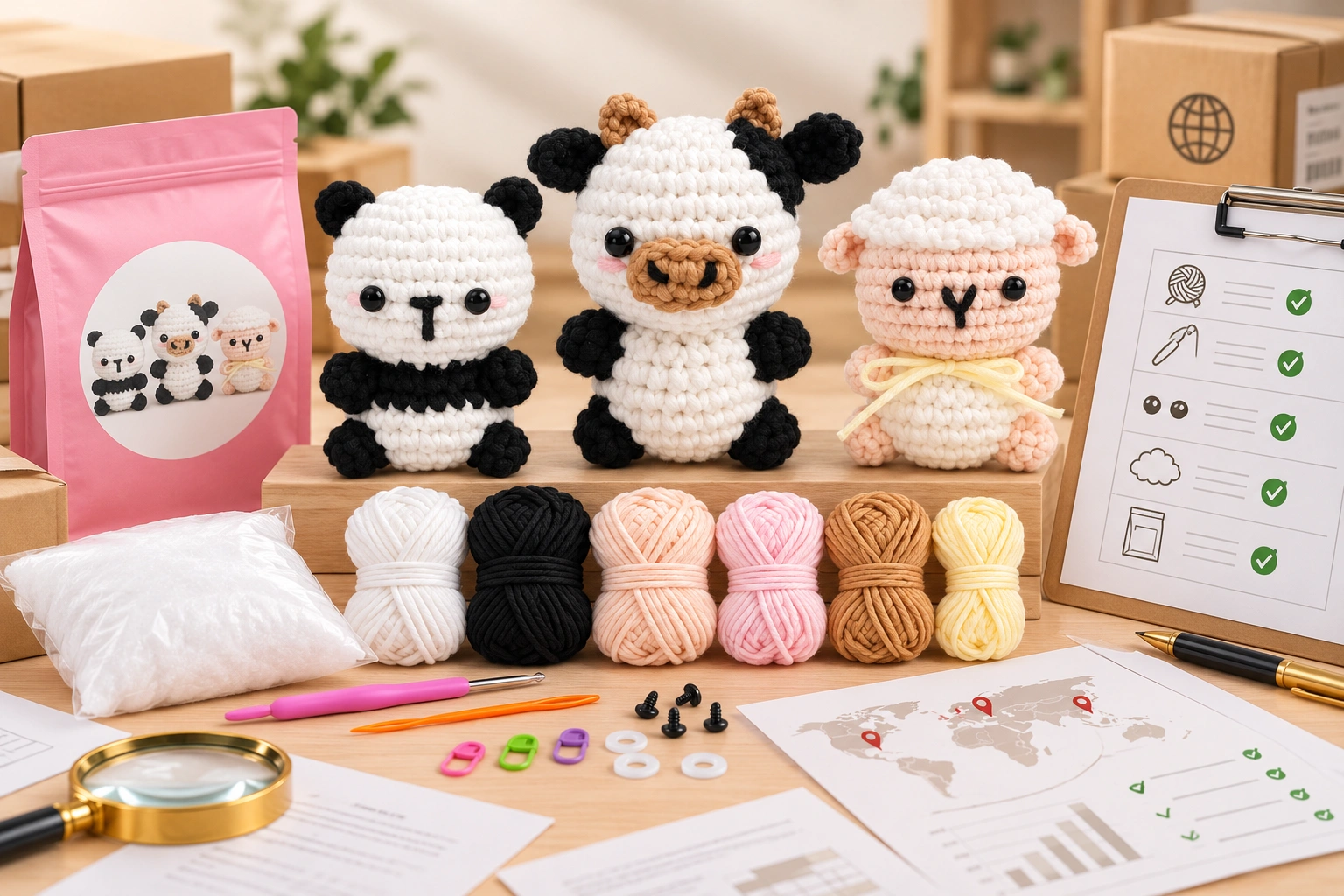
4. Make Sure Testing Matches the Product You Will Sell
A test report is useful only when its scope can be connected to the commercial product.
Before relying on a report, check:
- Product name, model number, and sample photographs.
- Materials, colors, coatings, and accessories represented.
- Applicable standards and editions.
- Test methods, results, exclusions, and limitations.
- Laboratory qualifications or acceptance where required.
- Differences between the tested sample and the production version.
Ask a specific question:
Does this evidence cover our intended users, destination market, and final product configuration?
Avoid accepting “we tested a similar kit” as a complete answer.
A different accessory, material supplier, coating, or intended age group may affect the assessment. The appropriate response is to review the change and determine what additional evidence is needed.
Not every change requires full retesting. Equally, a previous report should not be assumed to cover every future variation.
5. Separate Test Reports, Declarations, and Product Claims
Buyers often receive several documents described collectively as “certificates.” Their purposes differ.
| Item | What it can demonstrate | What buyers should verify |
|---|---|---|
| Laboratory test report | Results for identified samples under stated test conditions | Sample identity, scope, applicable methods, results, and limitations |
| Children’s Product Certificate, where required in the U.S. | Certification of compliance with applicable children’s product safety rules | Correct issuer, product identification, cited rules, and supporting evidence |
| Declaration of conformity, where applicable | The responsible manufacturer’s declaration against relevant legislation | Product identification, legislation, supporting documentation, and authorized signature |
| Material declaration | Information about a stated material or component | Whether it covers the actual material and supports the question being assessed |
| Packaging artwork | The information and claims presented to customers | Consistency with the approved classification and compliance documentation |
A report is not government approval. A conformity mark is not a substitute for the underlying documentation.
Use precise claims. Statements such as “safe for all ages,” “certified worldwide,” or “non-toxic” should not appear without an appropriate basis and clearly defined scope.
6. Review Packaging and Online Listings Together
Packaging and product listings should describe the same product, intended users, and use conditions.
Review the following information wherever applicable:
- Product identity and model reference.
- Age recommendation and necessary warnings.
- Manufacturer, importer, or other required business details.
- Batch or other traceability information.
- Required conformity marks.
- Required language versions.
- Safety information customers need before purchase.
- Claims about the finished project.
A packaging statement describing an adult craft activity can conflict with an online listing advertising the same kit as a young child’s toy.
Maintain an approved listing reference alongside the approved packaging artwork. This helps distributors and marketing teams use consistent information.
7. Assign Responsibilities Before Production Starts
A supplier can provide product information and manufacturing records, but the buyer should identify who is responsible for each market-facing decision.
A practical project responsibility table may look like this:
| Work item | Owner to identify before launch |
|---|---|
| Destination markets and sales channels | Buyer or brand |
| Intended users and product positioning | Brand, supported by qualified review |
| Component specifications and production records | Manufacturer |
| Applicable testing scope | Responsible business, supported by a qualified laboratory or specialist |
| Market-specific labeling and importer details | Relevant brand, manufacturer, or importer |
| Packaging and listing approval | Named approval owner |
| Product-change review | Buyer and manufacturer through an agreed process |
| Complaint handling and corrective action | Identified responsible businesses |
This table organizes the project. It does not transfer statutory obligations away from the parties that hold them under applicable law.
Agree on who commissions testing, receives reports, retains records, and approves changes. Unassigned responsibilities can delay a launch even when production is complete.
8. Create a Market Launch File
Keep the approved information in one controlled location.
A useful launch file includes:
- Intended-use and age-positioning brief.
- Destination-market classification review.
- Approved product specification and reference sample.
- Component and material information.
- Risk assessment and agreed testing scope.
- Applicable test reports and compliance documents.
- Approved packaging and required language versions.
- Approved online listing information.
- Responsible business contact details.
- Batch identification and change-control records.
Use version references that connect these records.
For example, a packaging approval should identify which product specification it belongs to. If the specification changes, the team should be able to determine whether packaging, testing, or listing information needs another review.
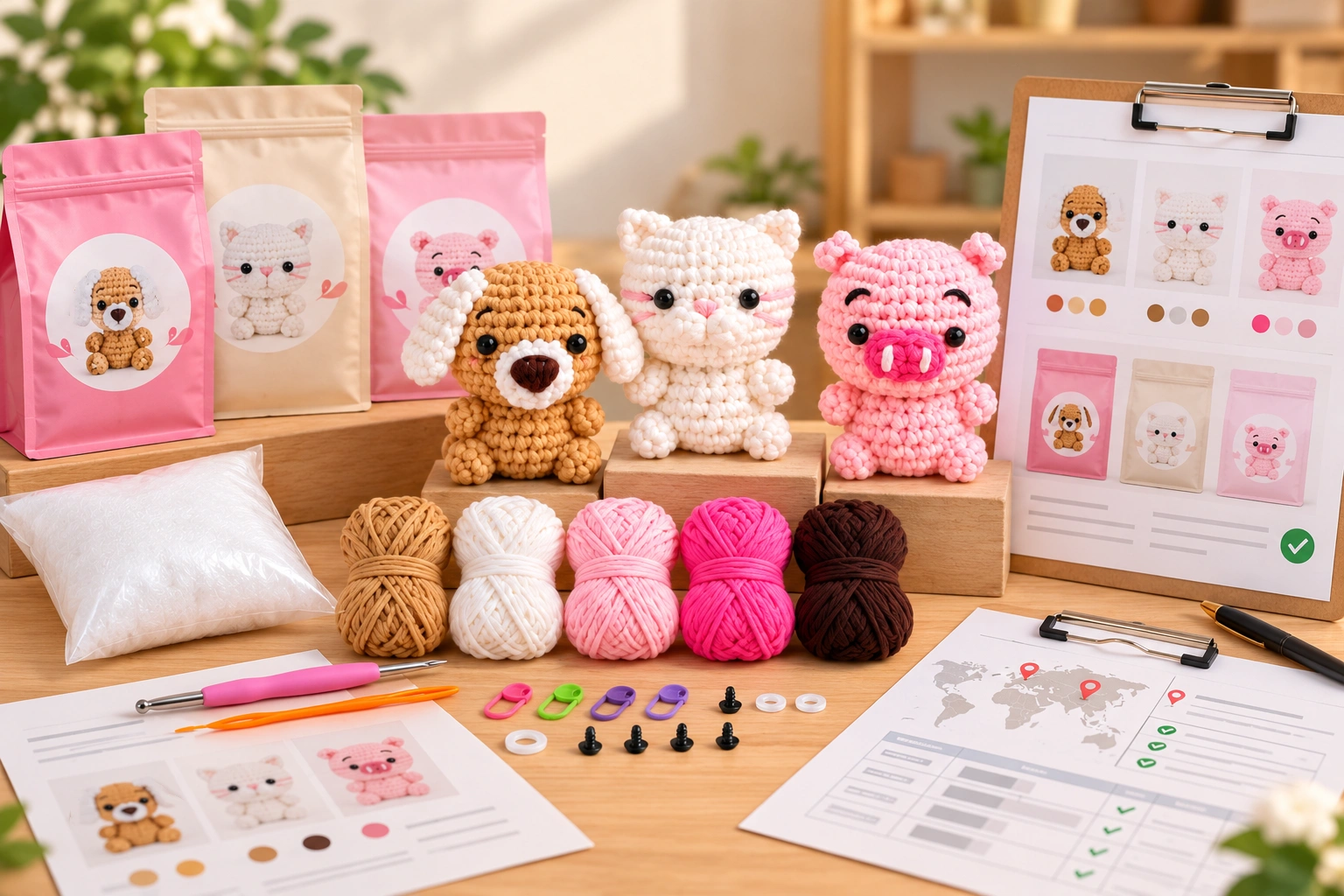
9. Establish a Release Decision Before Shipment
Set a clear release point before goods are shipped.
The decision should confirm that:
- Product classification has been resolved.
- Required evidence covers the approved configuration.
- Packaging and listing information have been reviewed.
- Required responsible-party information is available.
- Unresolved safety or compliance questions have been closed.
- Production changes have been evaluated.
Repeat orders also need change review. A replacement accessory, new yarn source, revised age claim, or additional destination market can affect the original decision.
Record whether each change requires no further action, a document update, additional assessment, or testing.
Planning a DIY Crochet Kit Project with UMY
An actionable sourcing brief should identify your destination countries, intended makers, finished-project use, sales channels, quantities, and packaging requirements.
For a project discussion with UMY, include any retailer manuals, laboratory protocols, or existing compliance requirements available to your team. These provide a clearer basis for reviewing product specifications and identifying questions that need specialist confirmation.
Manufacturing approval and market-release approval should both be visible in the project plan.
Share your target markets and intended users with UMY when discussing your next DIY crochet kit project, so the product brief can address these decisions from the start.
Frequently Asked Questions
Can one crochet kit be sold in several countries?
Potentially, but each destination needs review. Product design may remain consistent while labeling, responsible-party information, documentation, or other requirements differ.
Does a “14+” label remove children’s product requirements?
Not automatically. The actual design, intended use, packaging, advertising, and applicable classification rules matter. An age label should reflect a defensible assessment.
Does every crochet kit need CE marking?
No. CE marking applies to products covered by relevant EU legislation requiring it. Determine the product’s classification and applicable requirements before adding the mark.
Is a supplier’s test report enough to approve a launch?
Not by itself. Confirm that the report covers the actual product and relevant requirements, then review any additional documentation, labeling, and responsible-party obligations.
Should buyers approve packaging before confirming classification?
Confirm classification and applicable requirements before final packaging approval. Otherwise, the approved artwork may need changes to age information, warnings, marks, or business details.