
How Crochet Kit Manufacturing Systems Improve Cost Control and Repeatability
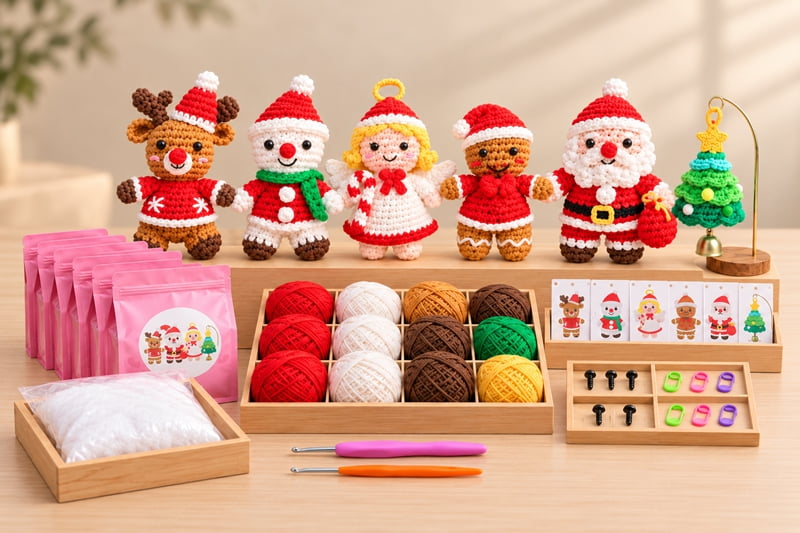
A crochet kit can look straightforward: yarn, a hook, a pattern, and a few accessories. Producing that kit repeatedly across different designs, packaging formats, and purchase orders requires a more coordinated system.
Crochet kit manufacturing systems help control costs by organizing approved components, product configurations, assembly instructions, and order records. Repeatability comes from making those decisions clear enough to reproduce across batches, while reviewing changes before they affect purchasing, packing, or customer experience.
For brands, retailers, and wholesale buyers, the benefit goes beyond a lower initial quotation. A well-defined system can reduce avoidable variation in what is purchased, how kits are assembled, and what must be clarified when the next order arrives.
These benefits depend on the product range, order volume, material availability, and implementation. Standardization does not guarantee a particular saving, and it should not remove features that customers need.
The practical question is: Which decisions should remain consistent, and which should vary by crochet kit?
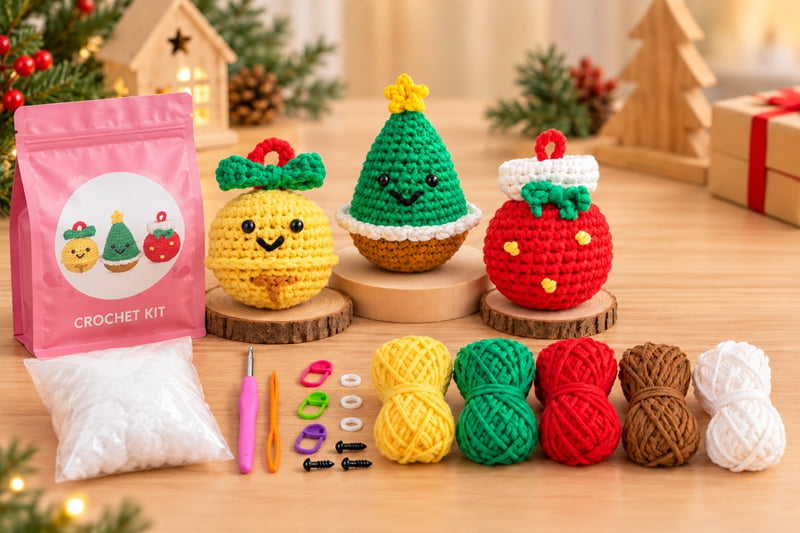
What Is a Crochet Kit Manufacturing System?
It connects decisions that might otherwise be managed separately:
- Which components are approved for each product.
- Which items can be shared across designs.
- How retail, workshop, and refill versions differ.
- Which instructions and packaging belong to each version.
- How changes are approved and recorded.
- What information is retained for the next production run.
A kit may contain individually acceptable components and still be commercially incorrect. For example, a refill version might receive a hook that was not included in the agreed price, or a retail version might receive packaging intended for classroom distribution.
Repeatability means reproducing the approved configuration and agreed product characteristics—not simply repeating the same packing actions.
Where Do Avoidable Crochet Kit Costs Come From?
The quoted component cost is only one part of a kit program. Buyers should also consider preparation, version changes, packing complexity, unused inventory, and corrections.
| Cost driver | How it can arise | Practical control |
|---|---|---|
| Too many component variations | Similar designs use different tools or packaging without a functional reason | Review opportunities for approved shared components |
| Unclear product versions | Retail, workshop, and refill configurations are not clearly separated | Assign distinct configuration references |
| Repeated assembly changes | Packing teams receive incomplete or changing directions | Approve assembly instructions before the production run |
| Packaging mismatch | Several box sizes are ordered before dimensions are confirmed | Evaluate packaging families using actual kit contents |
| Late substitutions | Unavailable materials require changes after preparation begins | Define substitution approval responsibilities |
| Incomplete reorder records | Buyers and suppliers must reconstruct previous decisions | Retain an approved reference package for each version |
These controls address avoidable work. They do not justify reducing required materials, removing useful instructions, or replacing approved components without agreement.
1. Separate Shared Components From Design-Specific Components
A collection does not need every component to be unique.
Some items may be suitable for use across several kits, while others directly determine how a particular project works or looks.
Shared Components
Potential candidates include:
- The same approved hook where project requirements allow.
- A common stitch-marker format.
- A standard storage pouch.
- An outer box used by several compatible designs.
- A consistent brand introduction card.
Design-Specific Components
These may include:
- Yarn selected for the particular pattern.
- Project-specific accessories.
- Printed patterns and tutorial references.
- Design labels and product identifiers.
- Inserts needed to organize a particular kit.
For example, using one hook across a collection is only appropriate if it works with the yarn and intended project outcome. A common outer box is useful only if it protects and presents each configuration adequately.
| Component | Question before standardizing |
|---|---|
| Crochet hook | Does the same specification suit every relevant project? |
| Yarn | Will the proposed yarn preserve the intended making experience and result? |
| Outer packaging | Does it accommodate the contents without unnecessary space or compression? |
| Printed insert | Is the information genuinely common to all included products? |
| Storage pouch | Can it hold each configuration and support the intended use? |
This review helps buyers preserve meaningful product differences while avoiding unnecessary purchasing and assembly complexity.
2. Give Each Commercial Configuration a Clear Identity
The same crochet project can be sold in several formats.
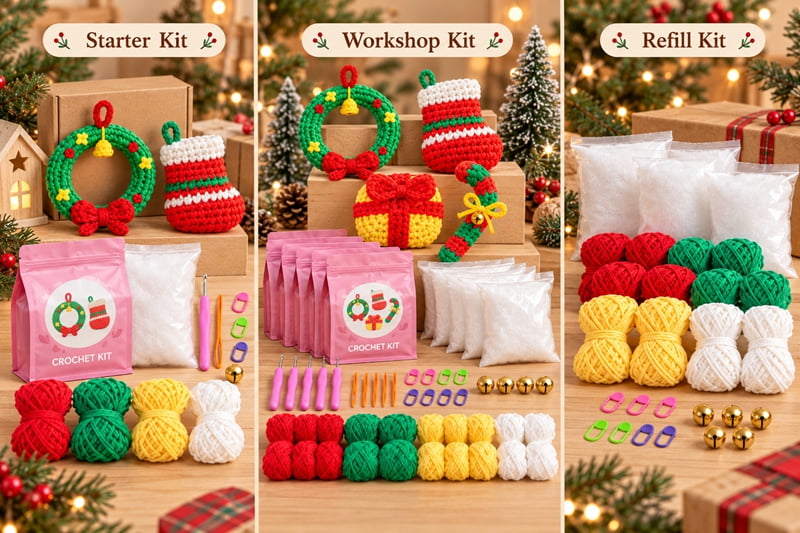
A retail starter kit may include tools and individual presentation packaging. A workshop version may use a different distribution format. A refill pack may exclude tools already owned by the customer.
These should be treated as distinct configurations.
Consider this illustrative structure:
| Configuration reference | Intended use | Main distinction |
|---|---|---|
| FLOWER-A-STARTER-V1 | Individual retail purchase | Includes approved tools and retail packaging |
| FLOWER-A-WORKSHOP-V1 | Facilitated group activity | Uses the agreed workshop distribution format |
| FLOWER-A-REFILL-V1 | Repeat purchase | Excludes reusable tools specified in the starter version |
The references above are examples, not UMY product codes.
Each configuration should identify its approved contents, instruction version, packaging, and effective revision.
A shared project name is not enough to distinguish products that have different costs or contents.
3. Plan Assembly Around the Actual Product Mix
Assembly becomes harder to manage when every order requires a different sequence, component layout, or packaging method.
A practical approach is to identify common preparation stages and then separate design-specific work.
For example:
- Prepare approved components shared by the relevant kits.
- Separate project-specific materials by configuration.
- Assemble each version using its approved instructions.
- Match the kit with its designated printed materials and packaging.
- Record completion against the relevant order and configuration.
The appropriate sequence depends on order size, component similarity, available space, and the consequences of mixing items.
Grouping similar preparation tasks may reduce repeated setup. However, placing visually similar materials together can create identification risks. Efficiency should therefore be considered alongside clear separation.
Buyers can ask:
“Which stages can be shared across our collection, and where do you separate the individual designs?”
The answer should explain the proposed workflow for the actual order.
4. Evaluate Packaging as a Product Family
Packaging decisions influence more than appearance. They affect purchasing quantities, storage, assembly, and shipment dimensions.
Before commissioning a different box for every design, buyers can assess whether several kits fit a common packaging format.
A packaging family might share:
- Outer dimensions.
- Structural construction.
- Insert format.
- Label placement.
- Carton packing arrangement.
Individual designs can still use different approved artwork or identifiers.
However, one format will not suit every kit. A larger project, additional tools, or a different retail display requirement may justify separate packaging.
The goal is to reduce unnecessary packaging variation while preserving protection, usability, and channel suitability.
Ask the manufacturer to explain which packaging features can remain common and which require separate evaluation. Any claimed shipping saving should be checked using actual packed dimensions, weights, and freight quotations.
5. Make Changes Visible Before They Create Costs
Changes are a normal part of product development and ongoing supply. The problem is an unrecorded change that affects other parts of the kit.
A yarn substitution may require a project review. A new accessory may alter the packing arrangement. Revised instructions may need to be separated from an earlier version.
A change record should answer:
- What is changing?
- Which configurations are affected?
- Why is the change proposed?
- Does it affect cost, timing, packaging, or user experience?
- Who must approve it?
- From which order or batch does it apply?
| Proposed change | Potential consequence | Decision required |
|---|---|---|
| Different hook specification | Changes tool suitability or user experience | Approve suitability before use |
| Revised box dimensions | Changes fit and shipment volume | Review the packed kit and logistics assumptions |
| Updated printed pattern | Creates more than one instruction version | Define the version transition |
| Alternative accessory | Changes appearance or construction | Review against the agreed product requirements |
A lower-priced replacement is not automatically an acceptable replacement. Buyers need visibility into both the proposed saving and its practical consequences.
6. Preserve a Useful Reference for Repeat Orders
A reorder should begin with a review of the previous approved configuration, followed by confirmation of anything that has changed.
Useful retained information includes:
- Product and configuration reference.
- Approved component specifications.
- Packaging and artwork versions.
- Instruction and tutorial references.
- Agreed assembly requirements.
- Approved changes from earlier orders.
- Relevant production observations.
The next quotation should identify whether it assumes the same configuration, quantity, and purchasing conditions.
Material availability, order volume, packaging quantities, and freight conditions may differ between orders. Those differences should be made explicit.
How Should Buyers Compare Manufacturing Proposals?
Comparing only the price per kit can hide important differences.
Two quotations may cover different tools, packaging formats, printed materials, or preparation responsibilities.
Before comparing prices, align the following:
| Comparison point | What to confirm |
|---|---|
| Product configuration | Are both quotations for the same kit version? |
| Component specifications | Are material and tool requirements equivalent? |
| Packaging | Are structure, printing, and inserts included on the same basis? |
| Development work | Which initial preparation charges are separate? |
| Order quantity | Are quantities stated per design, configuration, or total order? |
| Change management | How are substitutions and revisions approved? |
| Repeat orders | Which references will be retained and reviewed? |
| Delivery scope | What packing and shipping assumptions are included? |
For internal evaluation, buyers can use:
Comparable program cost = quoted goods + separately charged development and packaging setup + buyer-managed preparation + logistics under the agreed delivery terms.
Keep uncertain future costs separate from confirmed charges. Do not assign an assumed financial saving to fewer errors or faster assembly without supporting records.
Applying This Approach With UMY
UMY has worked in crochet product development and manufacturing since 2013. For a crochet kit inquiry, a useful starting point is the intended product range and commercial configuration—not only a photograph of the finished project.
Buyers can provide:
- Proposed designs and versions.
- Sales channels or activity settings.
- Estimated quantities per configuration.
- Required tools and packaging.
- Existing patterns, artwork, and tutorial assets.
- Expected reorder arrangements.
These inputs provide a clearer basis for discussing shared components, design-specific requirements, production preparation, and quotation scope.
Any proposed standardization should remain subject to product suitability, sample review, and agreement on the final configuration.
Frequently Asked Questions
Does standardization mean every crochet kit must look the same?
No. Designs can retain different characters, colors, and project outcomes while sharing suitable tools, packaging structures, or preparation methods. Standardization should preserve the differences that matter to customers.
Is a manufacturing system useful for a small collection?
Yes, particularly when the collection has several versions or is expected to be reordered. The documentation can remain proportionate: clear configuration references and approved versions are more useful than unnecessary paperwork.
Can starter kits and refill packs share materials?
They can share approved project materials where suitable. Their contents and prices should still be defined separately so that reusable tools are included or excluded deliberately.
What if an approved component becomes unavailable?
The supplier should identify affected configurations and propose an alternative for review. Approval should consider suitability, appearance, instructions, packaging, cost, and timing before the replacement is used.
How can buyers tell whether cost control is improving?
Track comparable orders and actual records, such as preparation time, configuration errors, rework, and unused components. Keep order size and specification changes visible when interpreting results.
Plan a Crochet Kit Range That Is Easier to Reorder
Effective cost control starts with clear product decisions: suitable shared components, distinct configurations, practical assembly instructions, and visible changes.
Together, these make it easier to understand what a quotation includes and to reproduce the approved kit on a later order.
Planning a crochet kit collection? Share your designs, intended channels, estimated quantities, and packaging requirements with UMY to discuss which elements can be standardized and which should remain specific to each project.