Which Crochet Kit Projects Fit Gift Shops, Bookstores, and Craft Stores?

Gift shops should consider crochet kit projects with a clear gifting occasion and an appealing finished result, such as flowers, small characters, and decorative pieces. Bookstores can evaluate projects connected to reading, nature, or their wider stationery and lifestyle assortment. Craft stores can build ranges around techniques, skill progression, and the materials their customers already use.
The right project depends on why customers visit the store, who will make it, and how much support they can access after purchase. A recognizable design helps attract attention, while suitable difficulty, clear instructions, and practical packaging support the purchase and making experience.
For retail buyers, project selection should connect the finished object with the actual work required to create it. A small crochet animal may involve several assembly steps. A bookmark may look straightforward but require careful tension control to remain flat.
Start with the store’s customers and merchandising plan, then evaluate the project through a complete kit sample.
Compare the Three Retail Environments
The following project directions are starting points for assortment planning. Buyers should validate them against their own customer feedback, price positioning, and sales results.
| Store type | Purchase context to evaluate | Crochet kit projects to consider | Main selection question |
|---|---|---|---|
| Gift shop | Customers buying for another person or a specific occasion | Flowers, small animals, decorative projects, and paired designs | Can the purchaser understand who would enjoy making this? |
| Bookstore | Customers exploring books, stationery, reading accessories, and related gifts | Flat bookmarks, botanical projects, small desk decorations, and original story-inspired characters | Does the project connect naturally with the store’s assortment? |
| Craft store | Customers buying materials, learning techniques, or choosing their next project | Introductory projects, amigurumi, practical accessories, and skill-building series | Does the project match a defined skill level and offer a satisfying next step? |
Store formats can overlap. A bookstore with an established craft section may support a more technical assortment, while a craft store with a strong gift business may need presentation suitable for gift purchasers.
1. Which Crochet Kit Projects Fit Gift Shops?
Gift-shop buyers need to consider two audiences—the person purchasing the kit and the person receiving it.
The purchaser may choose mainly by appearance. The recipient will experience the yarn, instructions, construction, and assembly.
Select a project that makes an attractive gift and sets a realistic expectation for the maker.
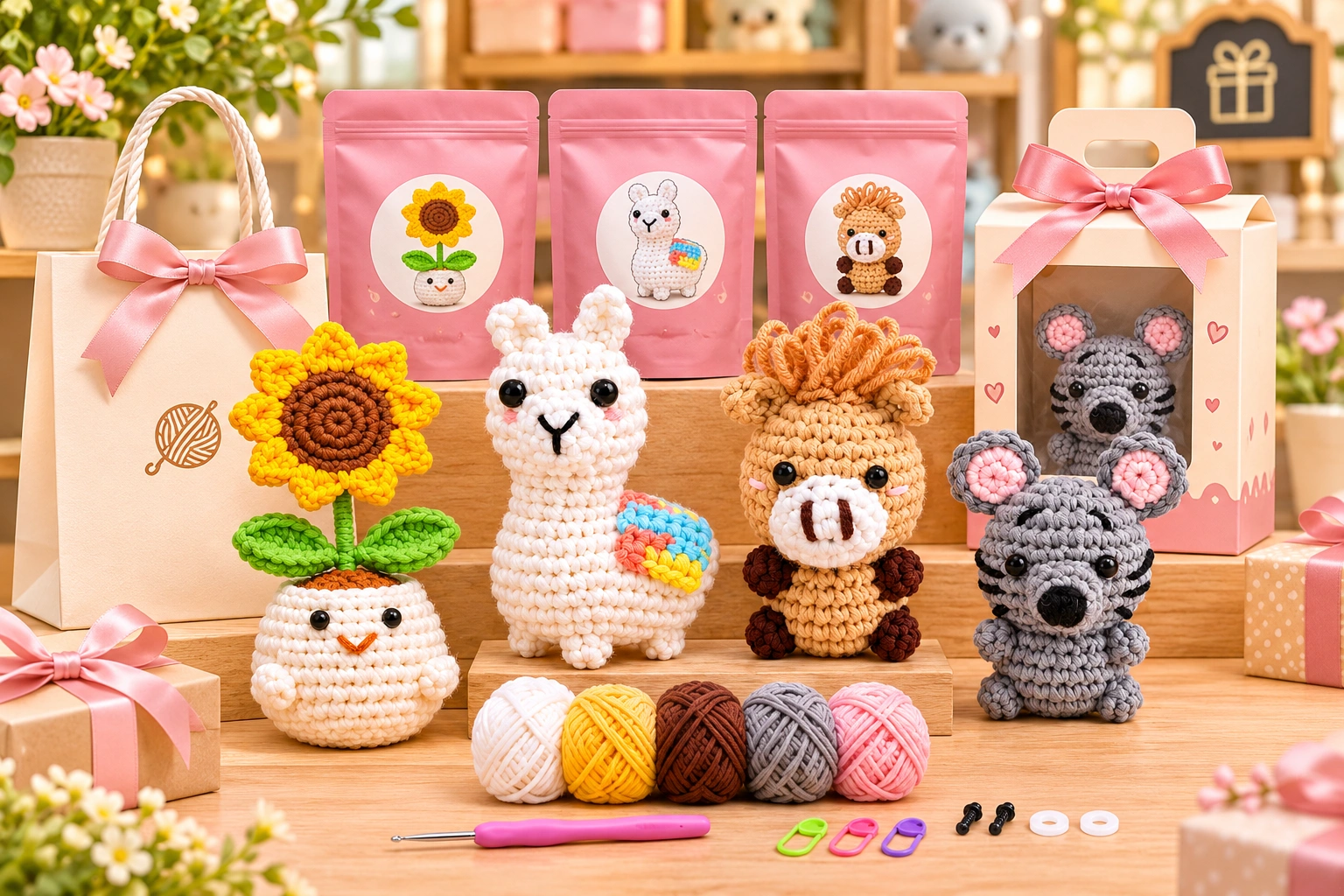
Flower and Botanical Projects
These projects can be considered for birthdays, appreciation gifts, or a store’s floral and home-gift assortment.
Evaluate the construction before assigning a skill level. Multiple petals, separate leaves, narrow stems, and repeated assembly can increase the work involved.
For an introductory offer, assess whether the design can achieve its intended appearance with fewer separate parts and clearly demonstrated finishing steps.
Small Animal and Character Projects
A small character can provide a distinct visual identity within a gift assortment.
Consider the design’s expression, proportions, color palette, and finished use. Then review how the customer produces those details.
Tiny ears, several limbs, embroidery, clothing, and accessories may require substantial finishing even when the finished object is compact.
Ask to see the unassembled components alongside the completed reference sample. This makes the making requirements easier to assess.
Decorative and Paired Projects
A small hanging decoration, desk piece, or pair of coordinated projects may suit a defined gifting occasion.
For paired kits, clarify whether the pack contains enough materials for both projects and whether they can be made independently. If two people are expected to work together, review whether the tools and instructions support that arrangement.
The package should make the quantity and expected result clear.
2. Which Crochet Kit Projects Fit Bookstores?
Bookstore crochet kits should have a clear relationship with the surrounding merchandise.
Review where the kit will sit—near craft books, journals, reading accessories, nature titles, or the general gift section. That location helps define which project customers are likely to understand.
Bookmarks With a Practical Reading Function
Bookmarks offer an immediate connection to reading, but the finished construction needs testing.
Check whether the section placed inside the book remains sufficiently flat, whether decorative details catch on pages, and whether the project performs as shown.
A flower or character attached to a bookmark may need to remain outside the closed book. Show that use clearly in product photography.
If a project is mainly decorative, describe its intended function accurately.
Botanical and Nature-Themed Projects
The connection should be visible through the project and display.
For example, a store could trial a compact botanical kit near a relevant book selection, supported by a completed display sample. The trial should assess whether customers understand the association and whether the kit earns its allocated space.
The kit still needs to stand alone for customers who purchase it without an accompanying book.
Original Characters and Desk Decorations
Small original characters can suit a bookstore’s stationery or desk-gift section when their appearance and presentation fit the store.
An original animal, reading companion, or imaginative decorative character can provide a starting point for development.
Use original or appropriately authorized references when developing character-based projects. Record the source and approval requirements in the brief.
Avoid relying on packaging copy alone to create a relationship with books. The product should have a clear place in the assortment.
Check How Much Help the Customer Will Need
Bookstore staff may have limited time or crochet knowledge available for explaining a kit.
Test whether customers can identify the project, understand the required experience, and access guidance independently.
A QR code should lead to the correct tutorial, and essential starting information should be easy to locate after opening.
3. Which Crochet Kit Projects Fit Craft Stores?
Craft-store buyers can evaluate projects as part of a learning path.
A customer might be purchasing a first kit, practicing an unfamiliar construction method, or moving toward more detailed work.
Give each project a defined role in the range so customers can choose according to their actual experience.
Introductory Projects
Consider projects with visible stitches, manageable shaping, and clearly explained assembly.
Possible directions include a simple flat accessory, a basic decorative form, or a character developed with limited separate components.
Evaluate the entire sequence before describing the project as suitable for first-time makers.
A design using one main stitch may still require difficult shaping, precise counting, or detailed sewing.
Amigurumi and Character Projects
Amigurumi can provide opportunities to practice working in rounds, increases and decreases, stuffing, and assembly.
State which techniques are taught and which customers are expected to know already.
Within a series, keep skill descriptions consistent. A customer moving from one kit to the next should be able to understand what additional work is involved.
Practical Accessories
Pouches, coasters, and other usable projects can offer a clear purpose.
Their function should be checked using the proposed yarn and construction.
A pouch needs appropriate proportions and a workable closure. A coaster needs a suitable contact area and stability for its intended use. A project’s visual appeal should be reviewed alongside these practical requirements.
Skill-Building Series
A craft store could evaluate a sequence that introduces additional techniques across several kits.
For example, one project might focus on basic stitches, another on shaping, and a later project on color changes or more involved assembly.
This is a proposed assortment structure. Confirm the progression through making trials and customer feedback before expanding it.

4. Evaluate Project Difficulty Separately From Finished Size
Size is one part of the assessment.
A small object may have tightly worked sections and tiny assembly points. A larger project may use a repetitive structure that is easier to follow, although it requires more making time.
| Project characteristic | What buyers should examine |
|---|---|
| Stitch visibility | Can intended users identify stitches and count their work? |
| Shaping | How often do increases, decreases, or directional changes occur? |
| Color changes | Are transitions explained clearly and manageable for the stated level? |
| Separate components | How many pieces need identification, positioning, and attachment? |
| Finishing | Does the project require sewing, embroidery, closures, or structural assembly? |
| Repetition | Is the amount of repeated work appropriate for the intended customer? |
| Guidance | Can users follow the actual kit using the supplied instructions? |
Use these questions to compare projects that look similar on the shelf.
5. Choose Packaging Around the Store’s Display
Approve the package in the setting where it will be sold.
Gift shops may need clear gift presentation and an understandable skill description. Bookstores may need compact packs that sit comfortably beside books and stationery. Craft stores may prioritize visible technique information and clear differentiation between projects.
Across all three channels, show the finished result, included contents, and anything customers must supply.
Clearly identify a completed display item as an example of the finished project when it is separate from the kit contents.
6. Build a Focused Trial Assortment
Select a small number of projects with distinct roles.
A gift shop might compare a botanical project with a character kit. A bookstore might test a bookmark and a desk decoration. A craft store might compare projects at two clearly defined experience levels.
Use the trial to decide which project deserves replenishment, revision, or replacement.

How UMY Supports Retail Crochet Kit Development
UMY has worked in product development and manufacturing since 2013.
For crochet kit projects, development discussions can connect the finished design with yarn selection, construction, tutorial requirements, component planning, and private-label packaging.
A store-specific brief helps define the sample to develop.
For a gift-shop project, that may include recipient experience and gift presentation. For a bookstore, it may focus on the project’s relationship with the assortment and independent tutorial access. For a craft store, the brief may emphasize techniques, skill descriptions, and progression across the range.
Provide the store type, intended maker, proposed project, target price positioning, destination market, quantities, and display requirements.
Review the complete packed sample and making experience before approving the commercial configuration.
Frequently Asked Questions
Which crochet kit should a gift shop test first?
Choose a project with an understandable finished result and a clear place in the existing gift assortment. Validate the recipient’s making experience before deciding on a larger order.
Are crochet bookmarks always suitable for beginners?
Suitability depends on the pattern, tension requirements, yarn, finishing, and guidance. Test both the making process and the bookmark’s performance inside a book.
Should craft stores carry several skill levels?
Several levels can work when customers can distinguish them and each has a clear role. Begin with the levels the store can explain and support, then use customer feedback to guide expansion.
Can the same project sell in all three store types?
Potentially. Its presentation, instructions, and positioning should fit each audience. Keep any channel-specific pack versions clearly identified.
What should buyers send when requesting samples?
Include the store type, target customer, experience level, project references, expected finished size, packaging direction, quantities, and launch timing.
Developing crochet kits for a gift shop, bookstore, or craft store? Share your customer profile and merchandising requirements with UMY to discuss suitable projects and a practical sampling approach.